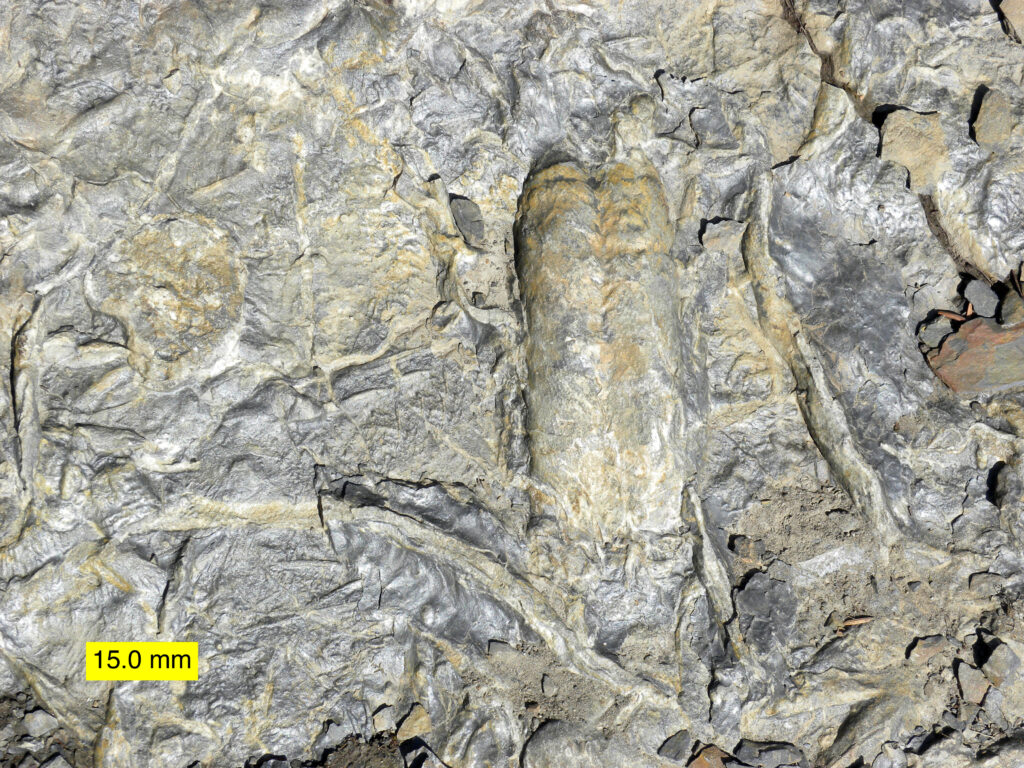
Imagine standing on a beach 555 million years ago. It’s quiet. Too quiet.
If you dove into the ocean, you wouldn’t see fish, crabs, or anything swimming toward you. You would mostly see a peaceful, slimy mat of microbes and soft, quilt-like blobs floating in the dark. No eyes were watching you. No teeth were waiting to bite you.
Then, in a geological blink of an eye, everything exploded.
Suddenly, the oceans were filled with creatures that looked like they belonged in a sci-fi movie. Monsters with five eyes, worms with spikes, and giant shrimp that ruled the world. This wasn’t an alien invasion; it was the Cambrian Explosion.
Here is the story of Earth’s most chaotic experimentation phase, and why you (and your cat) wouldn’t exist without it.
1. The “Big Bang” of Biology
For billions of years, life on Earth was microscopic and simple. But around 541 million years ago, something snapped.
According to the fossil record, nearly all the major animal blueprints (what scientists call “phyla”) appeared during this window. It was the moment nature stopped “doodling” with soft blobs and started creating complex machines with legs, shells, antennas, and backbones.
Scientists call this “The Cambrian Explosion.” It’s the evolutionary event that wrote the rules of life as we know it.
2. Meet the Cast: Nature’s “Rough Drafts”
If you visited the Cambrian ocean, you’d meet some truly bizarre characters. This was a time of high-speed evolutionary experimentation, or “morphological disparity” (a fancy term for different body shapes).
- The First Super-Predator: Anomalocaris (the “odd shrimp”) was the T-Rex of its day. It had two spiny grasping claws near its mouth and rippling fins to chase down prey.
- The Weirdo: Opabinia had five mushroom-like eyes and a long nozzle claw that looked like a vacuum cleaner.
- The Survivor: Among these monsters were tiny, worm-like swimmers with a stiff rod in their backs. These were the earliest ancestors of vertebrates—the great-great-grandparents of fish, dinosaurs, and eventually, us.
3. Why Did It Happen? (The 3 Triggers)
Why did evolution suddenly hit the gas pedal after idling for billions of years? Your source papers point to a “perfect storm” of triggers:
- The Oxygen Spike: Oxygen levels in the ocean likely increased. Oxygen is high-octane fuel for metabolism; without it, you can’t build a big, active predator.
- The Genetic Toolkit: Scientists believe the “Gene Regulatory Networks” (the software code for building bodies) were finally ready. Life had the tools to build complex bodies; it just needed a reason to use them.
- The “Ecological Arms Race”: Once the first animal developed a shell for protection, predators had to develop claws to crush it. This created a feedback loop. Every defense forced a new attack strategy, spiraling into an explosion of complexity.
4. Plot Twist: It Wasn’t Just One “Boom”
While pop culture loves to call it a single explosion, recent science suggests it was actually a trilogy.
According to current research, the Cambrian Explosion was likely a three-phased process.
- Phase 1: The arrival of small, soft-bodied pioneers.
- Phase 2: The “Explosion” of body plans and skeletons (the famous part).
- Phase 3: The Great Ordovician Biodiversification Event (GOBE).
Think of it like building a house. The Cambrian was when the foundation and walls were built (the main animal groups). The Ordovician (which came next) was when nature filled the rooms with furniture (the explosion of specific species and families).
The Bottom Line
The Cambrian Explosion was the most critical event in animal history. It solved what scientists call “Darwin’s Dilemma”—the mystery of why complex animals seemed to appear out of nowhere.
So, the next time you see a spider (Arthropod) or eat a fish (Chordate), remember: their family tree started 540 million years ago, in an ocean filled with monsters.
References
Servais, T., Cascales-Miñana, B., Harper, D.A.T., et al. (2023). “Cambrian explosion and Ordovician biodiversification or Cambrian biodiversification and Ordovician explosion?” Evolving Earth, 1, 100018.
Zhang, X. & Shu, D. (2021). “Current understanding on the Cambrian Explosion: questions and answers.” PalZ, 95, 641–660.
Zhang, X. & Shu, D. (2014). “Causes and consequences of the Cambrian explosion.” Science China Earth Sciences, 57, 930–942.