The “23andMe” Surprise
The relationship between Neanderthals and Humans is one of the biggest puzzles in evolution. If you’ve ever taken a DNA test, you might have seen a fun little statistic: “You are 2% Neanderthal.” This fact has led to a popular idea that Neanderthals and Humans weren’t really different, that they were just “us” with heavier brows. After all, if we had babies together, we must be the same, right?
Not so fast. Two major new scientific studies suggest that while we might have been “friendly” with them, Neanderthals and Humans were distinct in ways that go deeper than just biology, down to the very way we ate dinner.
1. The Biology: How Neanderthals and Humans Remained Distinct
A 2023 study published in Quaternary Science Reviews challenges the trend of “lumping” us together. The researchers argue that Neanderthals and Humans were distinct species, regardless of the interbreeding.
Think of it like Wolves and Coyotes. Wolves and coyotes can interbreed and have healthy puppies. But they are still different animals with different behaviors, habitats, and histories. The researchers point out that speciation isn’t a simple “on/off” switch; it’s a long process.
- Distinct Paths: We spent hundreds of thousands of years evolving separately. Neanderthals adapted to the cold of Eurasia, while Neanderthals and Humans‘ ancestors (us) evolved in Africa.
- Leaky Boundaries: Just because we swapped some genes when we met doesn’t erase millennia of separate evolution. We remained on different tracks until they disappeared.
(For more on how species evolve, check out the Smithsonian Human Origins Program).
2. Diet and Lifestyle: Neanderthals and Humans Ate Differently
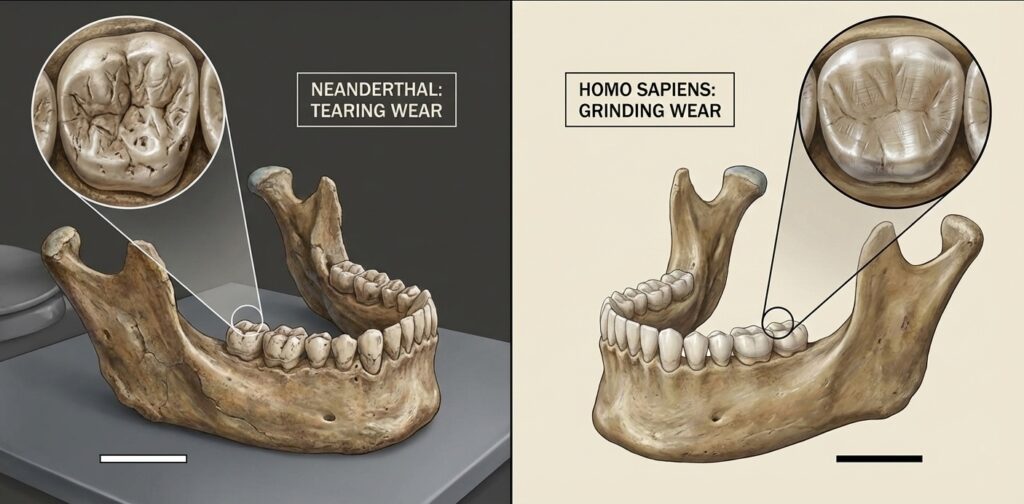
So, if we were different species, did we act differently? A fascinating 2024 study in the Journal of Archaeological Sciencelooked at the one thing that survives millions of years: teeth. Specifically, they looked at the microscopic wear and tear on molars to figure out what Neanderthals and Humans actually ate.
The “Warm Weather” Truce When Neanderthals and Humans lived in warm, Mediterranean forests, they were remarkably similar. Both groups were adaptable, eating a mixed diet of whatever was available. In these easy environments, we were practically neighbors with the same grocery list.
The “Cold Weather” Split The real difference appeared when the climate got tough. In the freezing steppes and pine forests, our paths diverged.
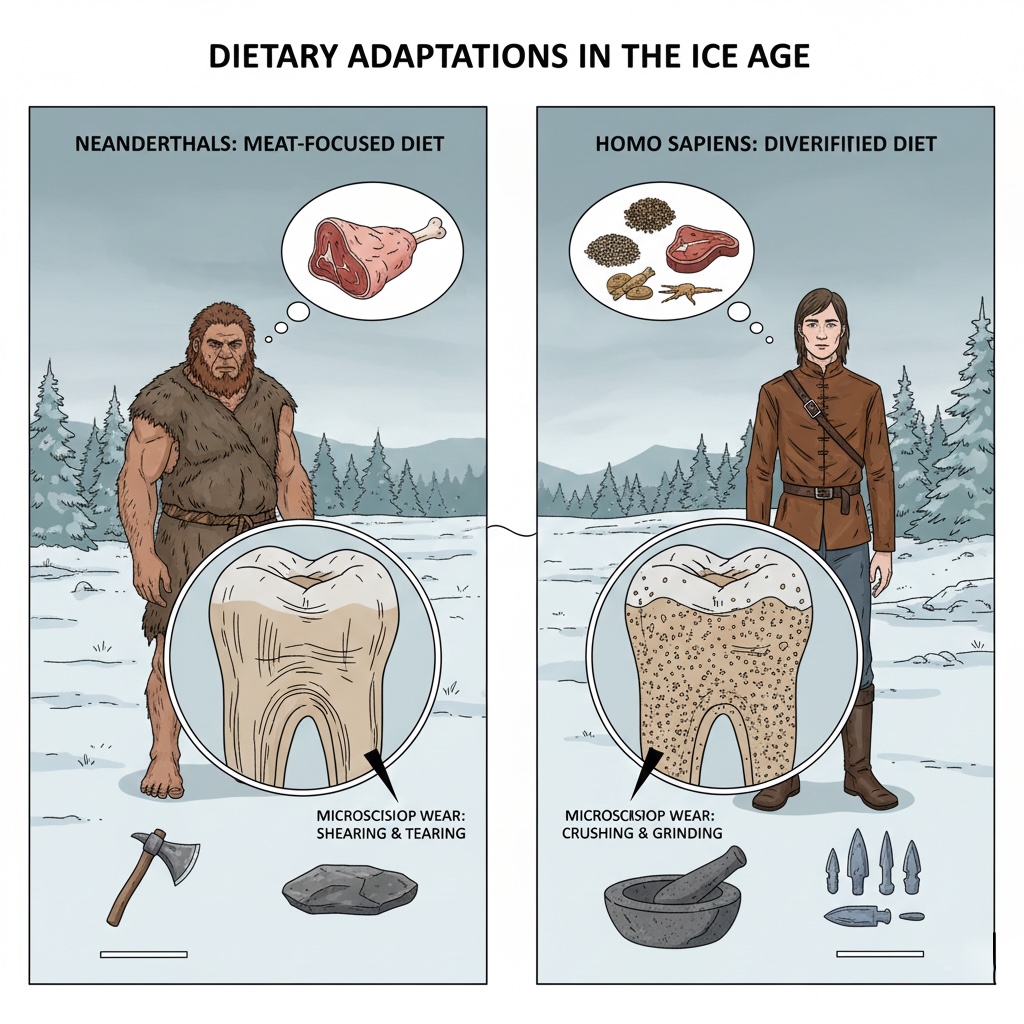
- Neanderthals: Their teeth show wear patterns typical of tearing and shearing food. They likely stuck to their traditional meat-heavy diet.
- Modern Humans: Our ancestors’ teeth showed signs of crushing and grinding—even in the same environment.
3. The Secret Weapon: The Kitchen
Why the difference in tooth wear? It wasn’t just about what we ate, but how we prepared it. The “grinding” marks on Human teeth suggest we were using technology that Neanderthals weren’t. We were likely using stone tools to grind seeds, pound roots, or process plants into flour or paste.
This processing introduced tiny bits of stone dust (grit) into the food, which marked our teeth. But more importantly, it allowed us to squeeze every calorie out of tough plants during harsh winters. While Neanderthals toughed it out, Neanderthals and Humans separated by their survival strategies—we engineered our way to a better meal.
The Verdict on Neanderthals and Humans
We are not just “Neanderthals with better haircuts.” We are a distinct lineage that survived not just because of our genes, but because of our culture. While we shared a bed occasionally, we didn’t share the same survival strategy. They were masters of their physical environment; we were the first masters of technology.
References
Meneganzin, A., & Bernardi, M. (2023). Were Neanderthals and Homo sapiens ‘good species’? Quaternary Science Reviews.
Hernaiz-García, M., et al. (2024). Diet of Neanderthals and early Homo sapiens from macrowear analysis of mandibular molars. Journal of Archaeological Science.